One city's musicians, venues, and fans in a single app, with the booking and the money handled in the middle.
ExpoReact NativeNext.jsTypeScriptFirebaseFirestoreCloud FunctionsStripe ConnectGitHub Actions
Planned, not launched, and not close. This page describes what GateKeep is meant to be. The screens on it are mockups drawn to the app's own design rules, and every act, venue, and show in them is made up.
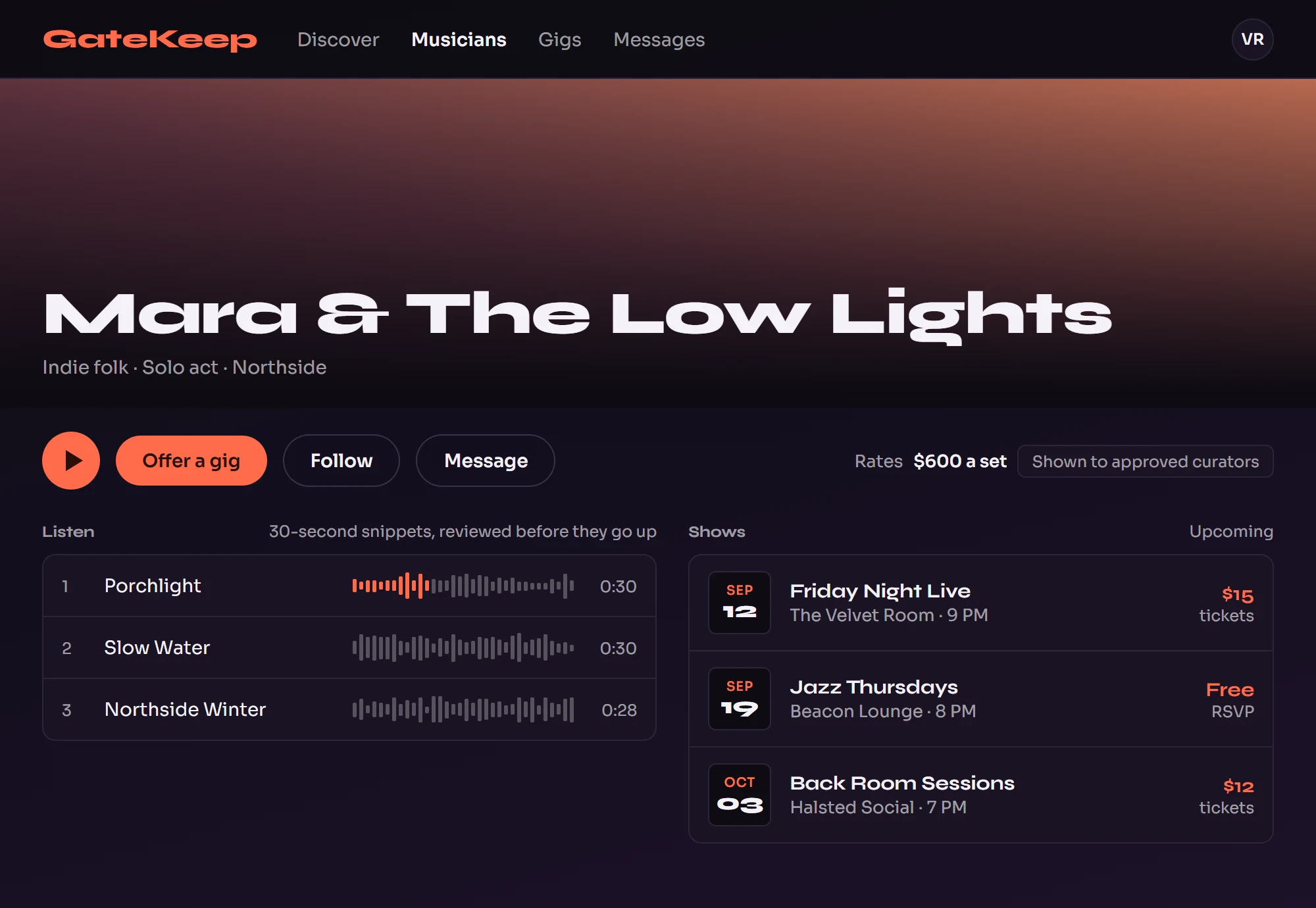
Mockup of an act's page as a venue would see it. The act is invented.
GateKeep is a marketplace for live music in one city at a time. It has three sides. Musicians keep a page that shows what they sound like and what they charge. Venues, planners, and hosts post the nights they need filled. Fans find out what is on and buy a ticket. The same booking that fills a venue's Friday becomes the show a fan sees on Thursday.
The name is the plan. Nobody is listed until a person has looked: every musician and venue profile goes from draft to review to approved, and every audio snippet is checked before it plays. That is slow by design, and it suits a launch in a single city better than one everywhere at once.
It is meant to earn from the first booking instead of waiting on scale: a fee on each gig, a small commission from the act, and a service fee on tickets. Advertising, subscriptions, guest checkout, seat maps, promo codes, and ticket resale are all left out of the plan on purpose.
What is planned
A page a venue can judge quickly
Each act gets one public page: a bio, photos, genres, links, and up to ten 30-second audio snippets, trimmed and transcoded on the server and reviewed before they play. Rates and booking preferences sit on the same page, and the act decides whether everyone sees them or only approved venues do.
Gigs posted once, or as a run
Venues, planners, and hosts get the same kind of profile and post the nights they need filled: a single date, or a recurring series that a daily job turns into real dates as they come up. A venue shows its address. A house show or a private event shows only its neighbourhood, and the exact address is released to the act once it is booked.
Terms first, then a handshake
Either side can open a booking. An act applies to an open gig, or a venue offers one directly. The two trade counter-offers in a thread that carries terms and nothing else, capped at fifty entries so it has to end. Accepting freezes the terms. Talking happens in messages, which are separate on purpose.
The money sits in the middle
Accepting charges the venue a 35% deposit. The rest is charged three days after the show ends, and the act's share moves to its own Stripe account from there. The venue pays an 11% booking fee on top of the agreed price and the act gives up 2% of it. A band can set percentage shares per member, and each settlement is split that way before anyone is paid.
Tickets, and the door
A venue can turn a filled gig into a public event, or publish one on its own, with free and paid tiers. The buyer pays a service fee of 7% plus 99 cents a ticket, never more than $3.99. The ticket is a QR code checked in once at the door by the venue's phone. Cancel the event and every order is refunded without anyone asking.
A way to find Friday night
Fans follow acts, venues, and genres. Following is what drives the notifications: a show announced, a lineup change, a new date, new music from someone they follow. A ranked deck and a searchable list cover the rest, sorted by distance, with a map on the results.
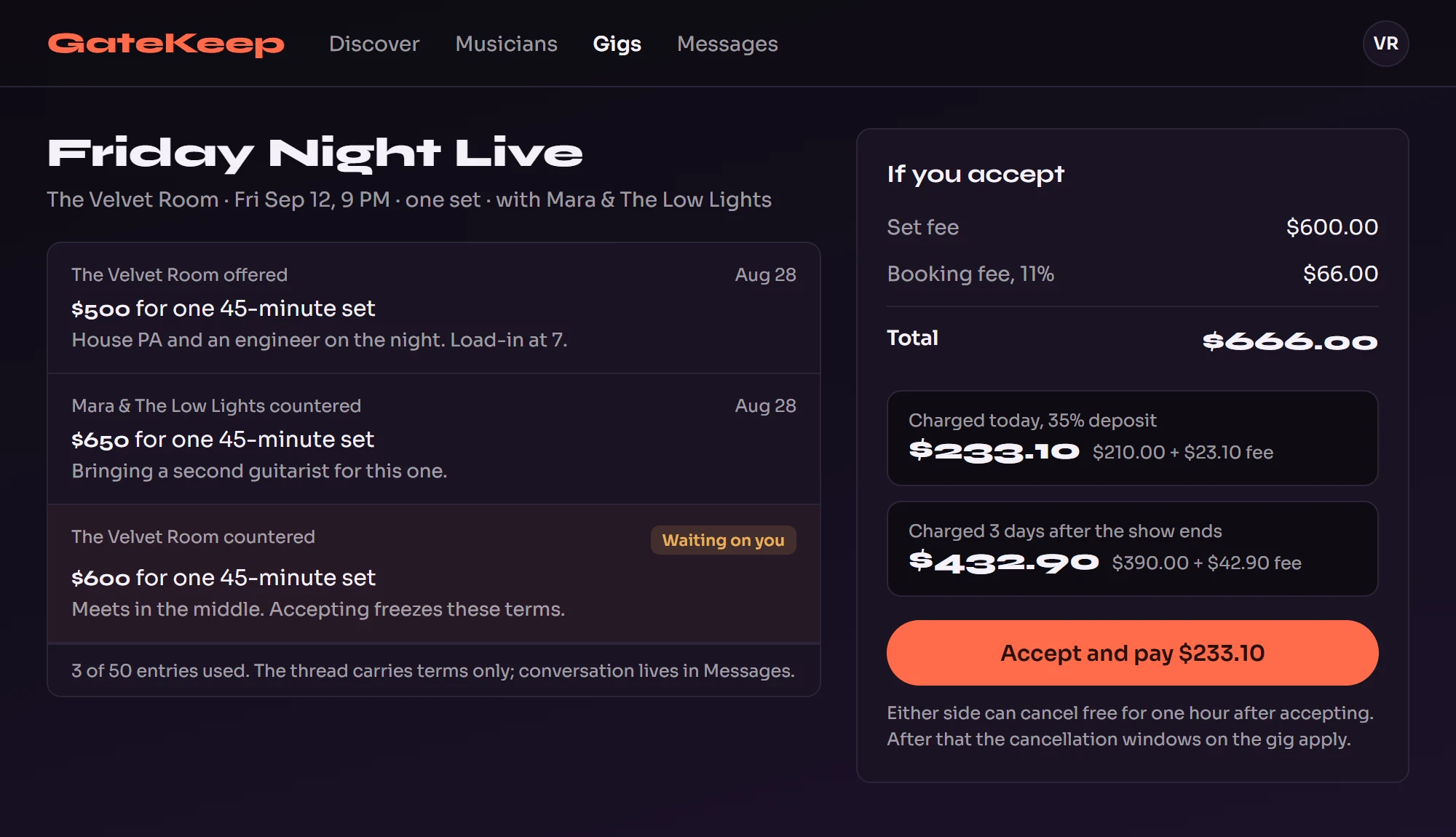
Mockup of a booking from the venue's side. The sums follow the planned fee rules: a $600 set costs the venue $666 and pays the act $588.
Sides to the marketplace3
Deposit charged when a booking is accepted35%
Booking fee, paid by the venue11%
Commission, paid by the act2%
Parts in the build plan12
Lines on the launch checklist65
Read from the project's planning record and fee constants as of 5 September 2026. Every figure can still change before launch.
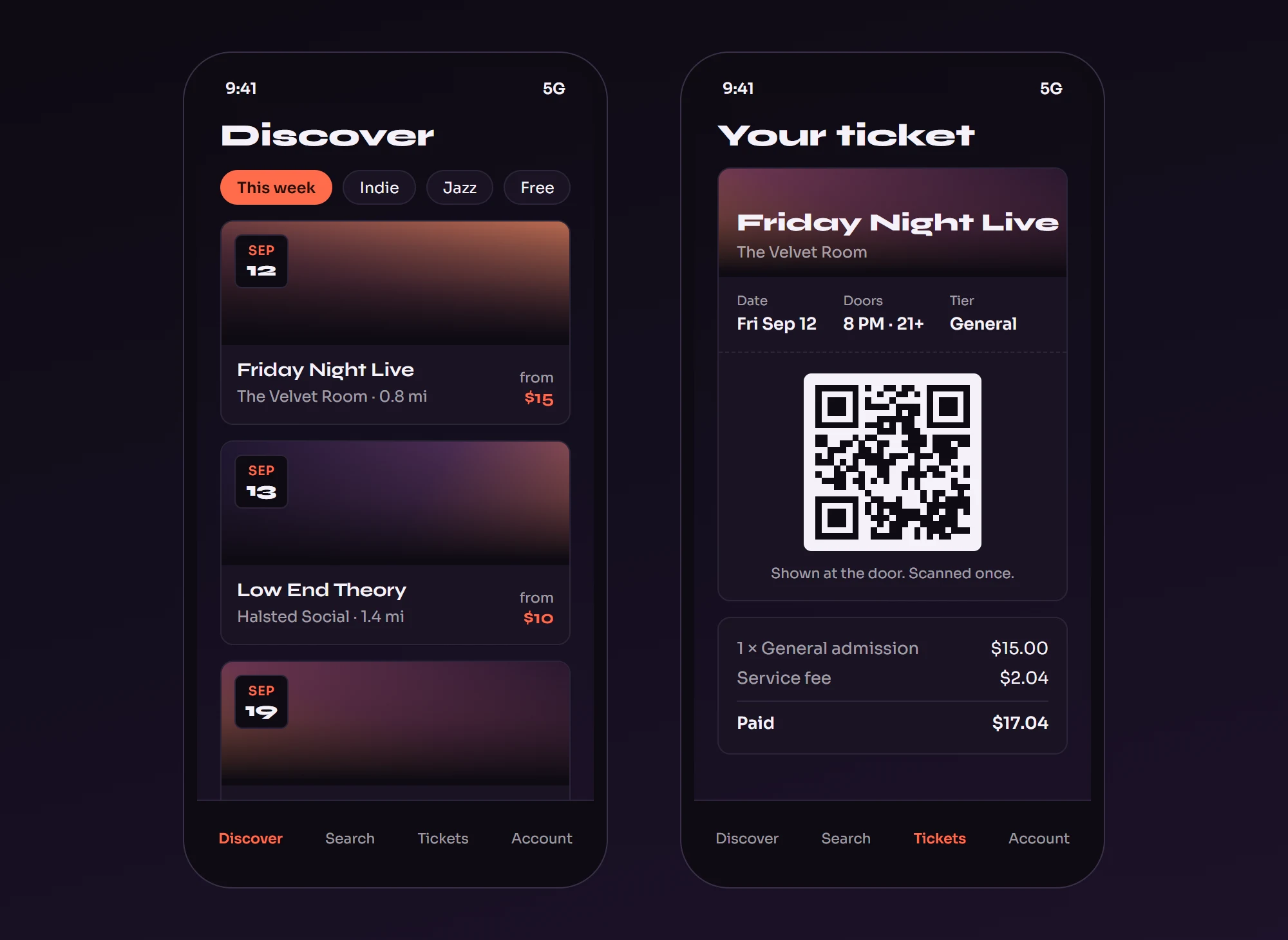
Mockup of the fan's side. The QR code is a drawing and encodes nothing.
Why the money is the hard part
A booking is two payments weeks apart, to a person who may be one of four in a band, from a venue whose card may decline on the second one. The plan gives each of those its own rule. Fees charged to a venue round up, shares paid to an act round down, and the remainder stays with the platform, all in whole cents. The fee rates are copied onto a booking the moment it is accepted, so changing them later never touches a deal already made.
A declined second payment is retried over the following days. If it still fails, a one-time 10% late fee is added, most of which goes to the act, and the venue cannot send or accept another booking until it pays. Either side can cancel free for an hour after accepting. After that, a venue that cancels inside three days of the show forfeits its deposit to the act, and an act that cancels inside one day takes a mark on the reliability record venues see beside its rates. All of it has to be right before a stranger hands over a card.
Where it stands: a first pass of all twelve parts was written between 24 August and 5 September 2026, and it passes its own tests against local emulators. That is a draft of the plan in code, and it is a long way from a product. It has not run on a real phone, taken a real card, or been deployed anywhere a stranger could reach.
What stands between the draft and a launch is mostly not code. The checklist runs to 65 lines: a production project under a business account, Stripe set up under that business, a lawyer's read of the terms and privacy text, real concert photography, device builds for both app stores, and a door scanner that has never seen a real camera. The app does not have a logo yet either. Its icon is still the one the framework ships with.