Every legal chess move, and twenty-one ways to break it.
ReactViteuseReducerAlpha-beta minimaxFirebase Realtime Databasenode:test
Playable now in three modes: hot-seat, against the computer, and online over a shared link. Two things are worth knowing before you start. The computer opponent plays eight of the twenty-one cards and holds the rest, because scoring the other thirteen needs an evaluation vocabulary it does not have. And the card art is a set of drawn silhouettes rather than illustration, a floor I could reach and verify at the size cards actually render, not a finished ceiling.
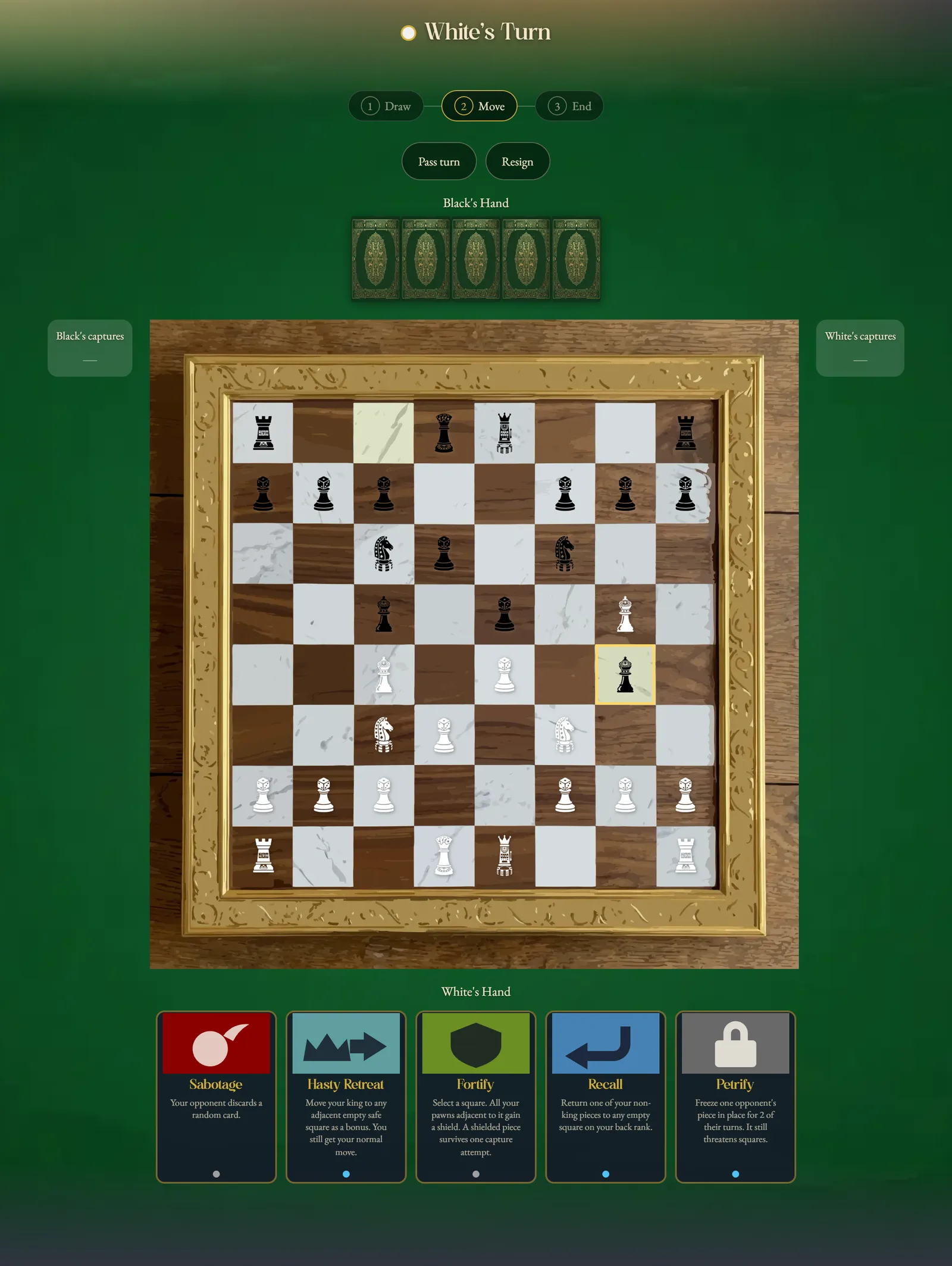
Chess Deck is chess with a deck built on top of it. Each turn you draw a card, may play one, and then move. The cards do things chess does not allow: freeze a piece where it stands, drop a rock on a square nothing can cross, mark a piece with a bounty, swap two of your own pieces, teleport your king out of a mating net. The chess underneath stays real. The cards bend it, and the engine's job is to make sure they never quietly break it.
That is the whole design constraint, and it decided the architecture. Every card had to be expressible as data plus one branch of a reducer rather than bespoke code, so the rules live in one place and can be tested without a browser. It is also where the hard problems were. A card that moves a pinned piece has to be refused, not merely warned about. Attack detection has to be separated from legal move generation, or a card that makes a piece uncapturable accidentally makes a king unable to be checked. Both of those shipped as bugs before the tests existed to catch them.
What it does
Chess first, cards second
The engine generates every legal move before a card is ever considered: castling rights, en passant, promotion, pins, discovered check, checkmate and stalemate. That layer is verified by perft, an exhaustive node count against published reference values, matching exactly to depth four from the opening position, 197,281 positions, and 97,862 from Kiwipete, the standard test position for castling and en passant. With no cards in play the game is ordinary chess, and the tests prove it rather than assume it.
Twenty-one cards, one targeting grammar
Every card is data: a rarity, a target type drawn from five values, an optional filter, and the number of steps its targeting takes. The board becomes a filtered picker driven by that declaration, so a card that captures an enemy piece and a card that blesses an empty square use the same machinery. The constraint was deliberate: no card gets bespoke UI code, because twenty-one bespoke paths is twenty-one places for the rules to drift.
Effects that outlive the turn
Nine states can linger after the card that created them is discarded: five on pieces (shielded, frozen, moving like a knight, bounty-marked, under vigil) and four on squares. Each carries its own expiry and the id of the piece it was cast on, so two copies of the same card cannot cancel one another. They used to: a second Petrify expiring unfroze the first victim early, which with duplicates in the deck happened routinely.
An opponent that plays eight of the twenty-one
The computer searches with alpha-beta minimax over material values and per-piece-square tables, and it plays cards, but only the eight whose effects it can evaluate. The rest it holds rather than playing badly. That is a limit worth stating plainly: a card-aware search would need to score board states that the evaluation function has no vocabulary for, like a square that will swallow the next piece to land on it.
Online without a server of my own
Two-player games run over Firebase Realtime Database rooms with onDisconnect presence, so a room cleans itself up when a player closes the tab. There is no backend process to deploy or keep awake: you get a link, you send it, the game starts. An earlier peer-to-peer WebRTC implementation was abandoned and its dead module deleted rather than left in the tree to imply an architecture the game does not use.
One reducer, five phases
Draw, card, move, promotion, game over: the whole game is one reducer of fourteen actions with no state outside it, which is what makes the engine testable in Node with no browser and no framework. The same reducer drives hot-seat, computer and online play; the modes differ only in who dispatches.
Cards in the game21
Cards in a shuffled deck44
Lingering effects a card can leave9
Turn phases in the state machine5
Cards the computer knows how to play8 of 21
Engine tests, zero dependencies84